
| The World of PhilatelyThe Making of a Stamp |
  The World of Philately The World of Philately |
So common are stamps that few of us pay attention to the intricate detail depicted on the face of such a utilitarian product, but to millions of stamp collectors around the world the issue of a new stamp is an eagerly anticipated event. These are the people who examine every mark on the stamp, who explore the lore of the subject and delight in the romance of its creation. In this article we take a closer look at what goes into the making of a stamp and particularly stamps produced by the Canada Post Corporation (CPC). During 1997 Canada Post will print more than a billion stamps, including 350 million commemorative stamps. Forty seven different stamps will celebrate nature, people, events and organizations important to Canadian business and culture, along with the production of stamps for everyday use. Commemorative stamps and related products will add more than 40 million Canadian dollars to the corporate income statement. Producing a stamp is perhaps the ultimate quest for perfection.It's the coordination of a million details, says CPC stamp design manager Georges de Passillé. We are like the conductors of an orchestra bringing in the trumpets here, the violins and bass there, on time to create the symphony. Our job with stamps is to direct the artists and designers, photographers and illustrators, the film and plate makers, the production technicians and operators to create the perfect miniature work of art."
The first stepWho decides what subjects will emblazon the stamps? Any Canadian with a suggestion may submit ideas for the consideration of Canada Post's Stamp Advisory Committee. This is a sub-committee of CPC's Board of Directors, explains Micheline Montreuil, director, Stamp Products. The committee comprises artists, historians, business people, stamp dealers and philatelists appointed by the Board. It meets several times a year to review the more than 200 ideas submitted, determine the yearly stamp programme, recommend it to the Board and approve the stamp designs. The objectives of the stamp programme are to represent some aspect of Canadian history, culture or nature, to encourage stamp collecting, especially among the youth, and to meet financial targets.At this stage stamp marketing staff step in. First a business plan is developed for each issue, which determines the number of stamps to be printed. Details are given for sales distribution, packaging, additional philatelic and retail products, such as souvenir sheets, uncut press sheets, promotional items paperweights, key chains, T-shirts, hats, mugs and advertising posters. Plans are also made for media coverage and communications with collectors, partnerships and strategic alliances with businesses, other postal administrations and cultural organizations.
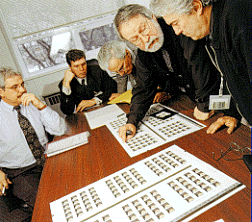
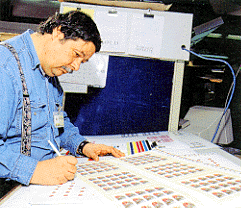
Creating a stampThe design, printing and finishing of a stamp is a collaborative process starting with the research, begins Bill Danard, design manager, Stamp Products. We want to know the subject thoroughly to determine what should be shown on the stamp and what visual material is available. With input from both marketing and design managers, refined designs are prepared for presentation to the Advisory Committee.During the design process the designer, design manager, film and colour experts, and printers consult about the size of the stamp, number of colours, paper stock, printing and finishing techniques. We use a variety of printing methods, lithography (offset) in up to nine colours, intaglio (engraving), or a combination of lithography and intaglio together with foil stamping and embossing. When the design work has been completed, we take the drawing, painting, photography, illustration or, most common now, cornputer-generated electronic artwork to the film house. There the electronic files are manipulated, colour separation films produced, printing plates developed and full colour proofs made. One unique production element, now being copied by other stamp-producing countries, is our use of stochastic screening on the film, giving us a much higher resolution. Before the printer goes on press for the production run, the stamp image is viewed at a number of proof stages to allow for colour corrections and adjustments and a process known as wet trap proving to replicate the approved ink image under production conditions. About 5000 press sheets are pulled at this stage, proofed and left to dry for 24 hours before the designer and design manager sign off on six sheets, retained for archival purposes. The remainder are destroyed.
Stamp finishing is the next stage. Perforation combs determine the size and proportions of stamps and can cost up to 35 000 Canadian dollars each. That's why perforation influences the original design, Danard elaborates. After perforation the press sheets go to the guillotine for specialized cutting. As part of the finishing process all stamps are inspected for flaws and defective work culled out. Stamps are designated as field stock meeting acceptable industry and operational standards - or as philatelic stock, which is inspected to a higher level and is trimmed differently. The finished products are packaged for shipping to Canada Post's National Philatelic Centre and to retail service centres, from where they are shipped to standing offer customers and to retail sales outlets. All printing waste and defective stamps are security-destroyed, witnessed and recorded, because stamps have a monetary value. The printers also have financial accountability for the product, concludes Danard. (Acknowlcdgment: Margaret Chartrand, Performance: Canada Post Corporation) |